Whakapapa
Family history software built around source material
Ownership
Solo Designer & Developer
Primary proof
Human approval
Overview
A family history app that turns documents, photos, and recorded stories into structured family records and a navigable tree.
The Challenge
Most genealogy tools are expensive, rigid, and centered on manual data entry. The goal here was to make source capture and review easier without asking users to trust raw AI output.
Constraints
- •Trust is fragile with family history data, so AI output must stay reviewable and reversible.
- •Many source artifacts are low quality scans and handwritten notes.
- •The product needed to be viable for a solo builder and affordable for families.
How it works
Problem
AI extraction can hallucinate relationships.
Decision
Added a suggestion queue with explicit human approval before writing to the tree.
Slightly slower ingestion versus fully automatic sync.
Impact
Higher confidence in accepted data and fewer correction loops.
Problem
Genealogy tools often bury stories under forms.
Decision
Made voice capture and story context first-class alongside people and dates.
More schema complexity and moderation edge cases.
Impact
Richer family context and stronger emotional retention.
Approach
1. AI Extraction Pipeline
Users scan or upload documents, OCR extracts text, and an LLM returns candidate people, dates, places, and relationships for review before anything is written to the tree.
2. Voice-First Story Capture
The app includes voice recording and transcription so spoken stories can sit alongside documents and photos.
3. Living Tree, Not Dead Database
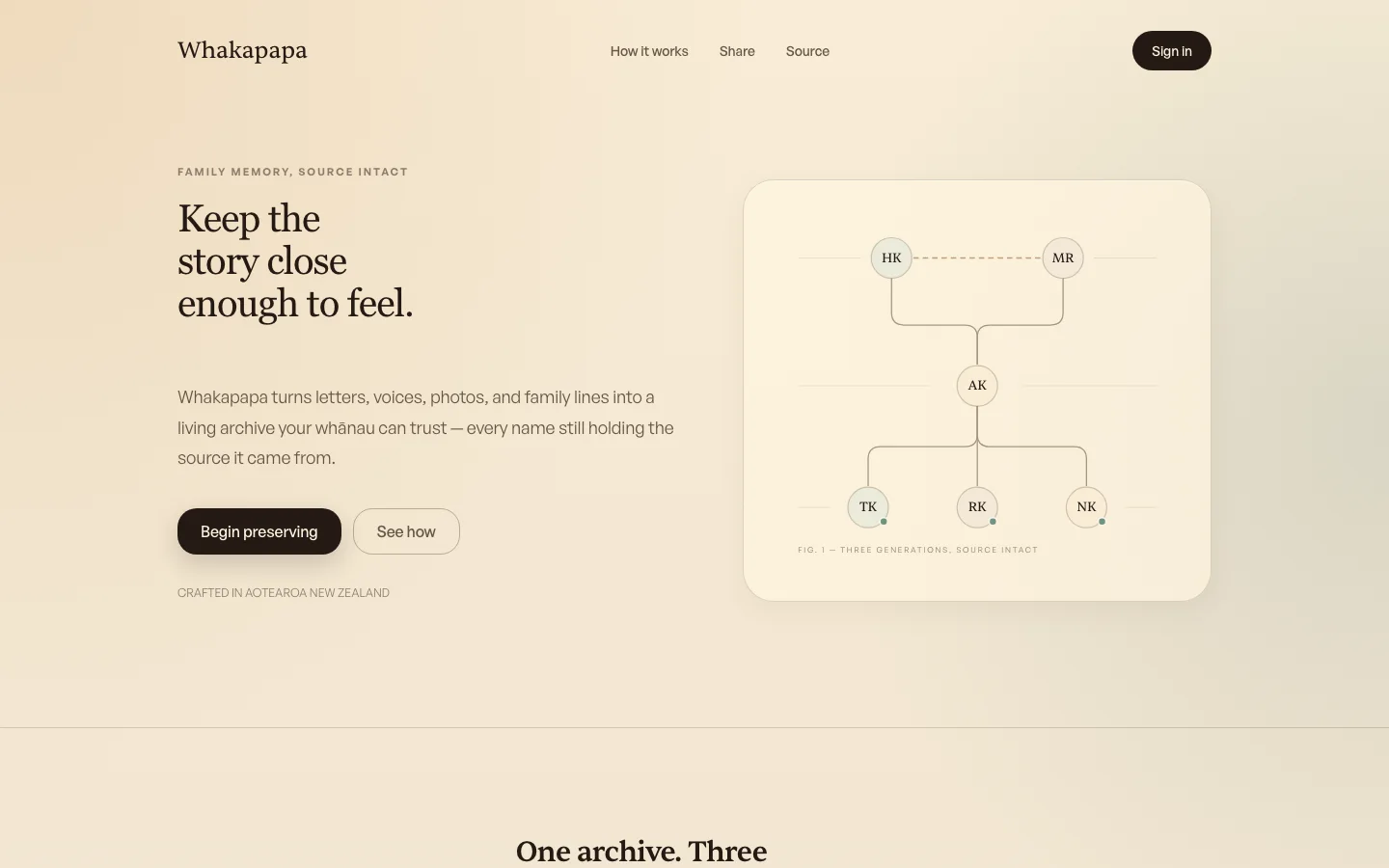
React Flow and dagre power the tree view, but the product is broader than a chart. Stories, documents, and media stay attached to the people they relate to.
4. Private by Default
Family records are protected with Supabase row-level security, and AI suggestions require explicit review before they can change the tree.
Outcome
A working genealogy product with document ingestion, review flows, voice capture, and a collaborative tree view.
Proof points
Human approval
Review gate
Documents + voice
Source capture
Private family records
Data model
Learnings
- →AI extraction needs a human review layer to be usable for family records.
- →Voice capture changes the value of the product because it preserves more than text alone.
- →Source material and context matter as much as entity extraction.
- →Supabase and Next.js made the solo build manageable without a separate backend service.
Anti-Patterns Avoided
- ×Auto-trusting AI inserts directly into canonical records.
- ×Forcing users into rigid, spreadsheet-like genealogy workflows.
- ×Locking export/import behind paid plans.
Next Iterations
- →Confidence scoring and source-level reliability badges per extracted entity.
- →Guided interview flows optimized for elder story capture sessions.
Get In Touch
If you want to talk about similar work, email me.
Contact is the simplest place to start.
Next project
Vape Quit Coach