Vape Quit Coach
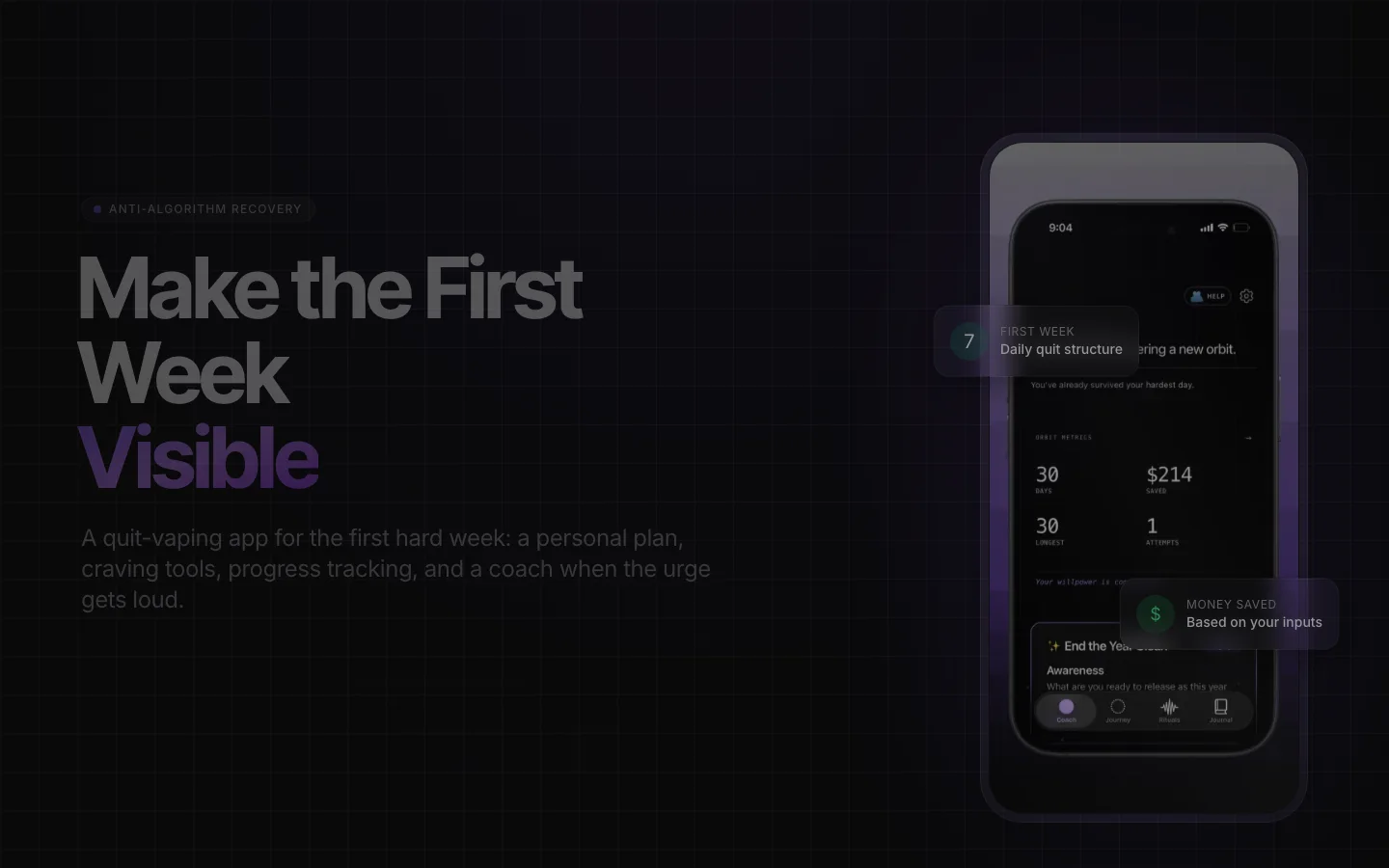
An iOS app for quitting vaping
Ownership
Solo Designer & Developer
Primary proof
Live on iOS
Overview
An iOS app for smoking cessation built around tracking, coaching, and support during cravings and setbacks.
The Challenge
Many quitting apps rely on brittle streak systems and punitive framing. The goal here was to build something calmer and more usable during difficult moments.
Constraints
- •Behavior change support had to avoid shame mechanics and relapse punishment loops.
- •Support screens needed short, readable actions for high-stress, low-attention moments.
- •Solo development required disciplined scope and clear UX priorities.
How it works
Problem
Streak systems create brittle motivation and anxiety.
Decision
Shifted progress framing from perfect streaks to identity and trend signals.
Less instantly gamified feedback.
Impact
The interface keeps reflection and support reachable after setbacks; engagement effects have not been measured.
Problem
Craving moments are noisy and emotionally charged.
Decision
Used calm, low-stimulus intervention screens with short actions.
Less visual spectacle during key moments.
Impact
Short actions and restrained visual density are the design choice; no clinical efficacy is claimed.
Approach
1. Behavioral Architecture
The product focuses on triggers, replacement habits, and support patterns rather than only on streak counting.
2. Progress as Identity
Progress is tracked in a way that still reflects forward movement after setbacks instead of resetting everything to zero.
3. Liminal Design
Intervention screens are intentionally low-stimulus so they stay usable during cravings and stress.
Outcome
The app is available on the iPhone App Store with quit tracking, reflection, breathing, and online AI coaching. These tools provide practical support; they do not establish clinical efficacy or a biological recovery schedule.
Proof points
Live on iOS
Availability
Solo shipped
Product scope
Learnings
- →Health products need a different interaction model than productivity tools.
- →Low-stimulus support flows matter more than high-energy motivation during cravings.
- →Working solo meant carrying the product from interaction design through implementation.
Anti-Patterns Avoided
- ×Punitive streak resets and public shame nudges.
- ×Engagement loops optimized for app opens rather than quit outcomes.
- ×Clinical fear-based copy during relapse-adjacent moments.
Next Iterations
- →Adaptive intervention timing based on user-identified trigger windows.
- →Deeper longitudinal insights that preserve privacy and dignity.
Get In Touch
If you want to talk about similar work, email me.
Contact is the simplest place to start.
Next project
Dayle Palfreyman